MarkAnn
Real-time, AI-powered market-alert platform for Indian stock markets (NSE).
MarkAnn watches NSE data streams, runs detection and AI analysis on what it finds, and delivers the results to users through configurable channels. It is built API-first: a gateway is the single public entrypoint, the backend API is the source of truth, an autonomous engine does the polling and processing, and a web console gives operators live control over the running system.
The first shipped feature is AI-powered corporate announcements — MarkAnn polls NSE press releases, reads the attached PDF (as images, with a text fallback), summarises and classifies it with an LLM, stores it, and publishes an alert to everyone watching that symbol.
Where to go next
-
How the four services fit together, and why. Start here to understand the system.
-
The component contract, step by step — the main way MarkAnn is extended.
-
Deploy, drive the admin console, and follow the runbook when something breaks.
-
Configuration, the data model, the Redis key map, and the API surface.
What makes it different
- Gateway-fronted, RBAC-secured. A single public gateway handles authentication (cookie-based JWT), role checks, and rate limiting, then reverse-proxies to an internal backend the internet never touches.
- DB-driven component registry. Pollers and processors are rows in Postgres, not hardcoded wiring. The engine loads only what is enabled, validates schema compatibility, and skips anything broken — no redeploy required.
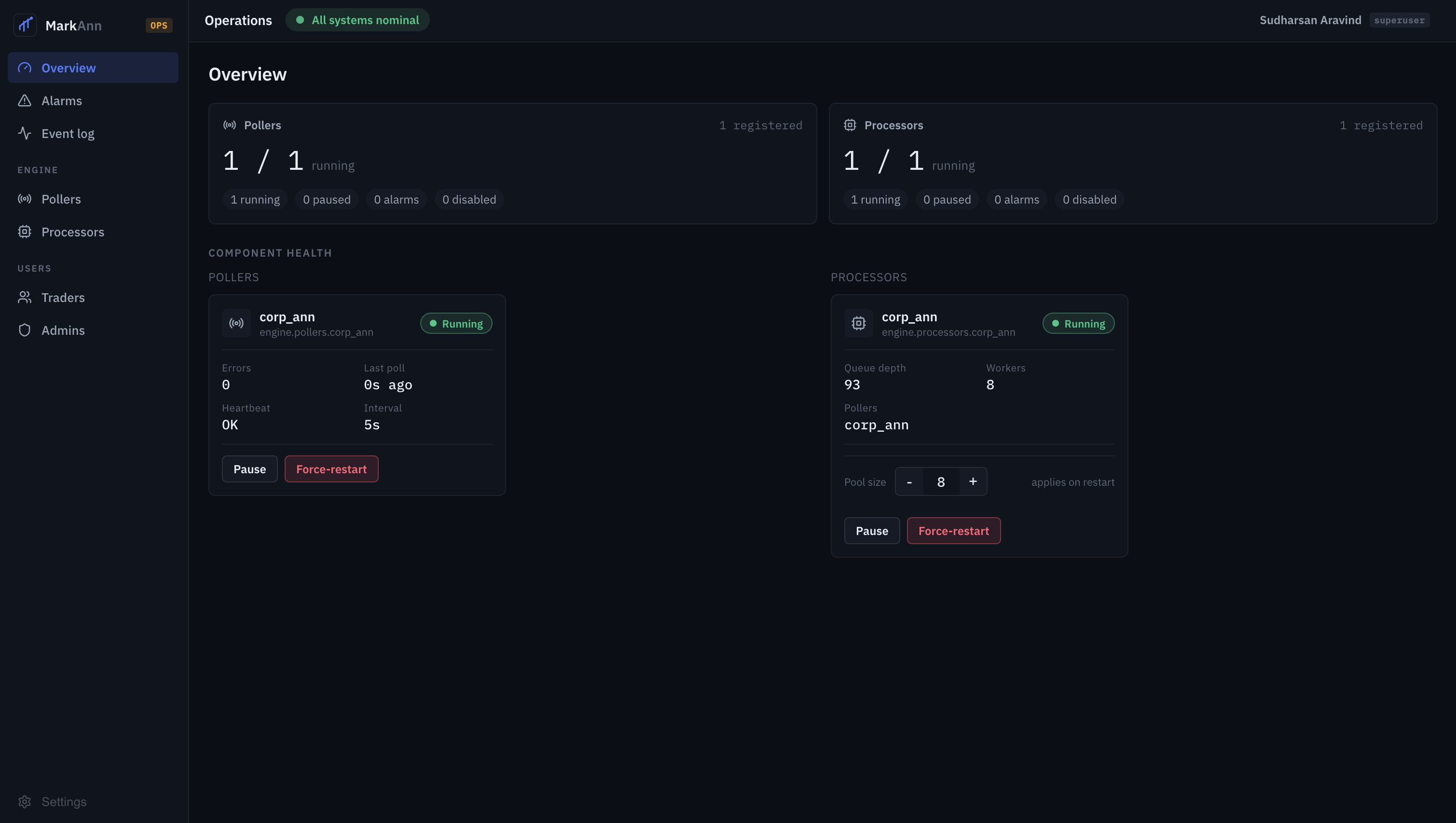
- Live operational control. Pause, resume, force-restart, and resize worker pools from the web console; commands travel over a Redis control channel to the engine in real time.
- Self-healing engine. A supervisor auto-restarts crashed tasks, a watchdog flags silent pollers, and a circuit breaker backs off failing data sources.
- Provider-agnostic AI. OpenAI, Anthropic, and Gemini are interchangeable via one env var — including OpenAI-compatible local servers such as vLLM.
The stack at a glance
| Layer | Technology |
|---|---|
| Language | Python 3.13 (managed with UV) |
| Gateway & API | FastAPI + Uvicorn |
| Database | SQLAlchemy 2 (async) + Alembic + PostgreSQL |
| Cache / queue / pub-sub | Redis |
| PDF handling | PyMuPDF |
| LLM | OpenAI · Anthropic · Gemini |
| Frontend | React + TypeScript + Vite + TanStack Query |
| Orchestration | Docker Compose |
New here?
The fastest path to a running system is the Deployment guide — one docker compose up brings up Postgres, Redis, migrations, registry seeding, all three backend services, and the admin console.